-
Technical Specifications
| Performance Parameters | ||
| Measured Variables | Mass Flow,Density,Temperature | |
| Nominal Diameter | U-tube Type: DN3 ~ DN150 | |
| Micro-bend Type: DN8 ~ DN100 | ||
| Straight Tube Type: DN8 ~ DN50 | ||
| Inverted Triangle Type: DN1 ~ DN2 | ||
| Turndown Ratio | U-tube: 10:1 | |
| Micro-bend: 10:1 | ||
| Straight Tube: 5:1 | ||
| Inverted Triangle: 10:1 | ||
| Density Measurement Range | (0.5 ~ 2.0) g/cm³ | |
| Temperature Measurement Range | (-240 ~ 350) °C | |
| Accuracy | Flow: 0.15%, 0.2%, 0.5% | |
| Density: ±0.001 g/cm³ (±1 kg/m³) | ||
| Temperature: ±1°C or ±0.5% of reading, whichever is greater | ||
| Repeatability | 1/2 of accuracy | |
| Output | ||
| Analog Output | (4 ~ 20) mA,Load resistance ≤ 750 Ω | |
| Communication Output | RS485 interface, MODBUS-RTU protocol,HART | |
| Pulse Output | Duty cycle: 10% ~ 90% | |
| ulse frequency: Max. 10,000 Hz | ||
| Active output | Output current: 10 mA | |
| Open-circuit voltage: 30 V | ||
| Power Supply | ||
| Power Supply | 24 VDC / 220 VAC | |
| Power Consumption | ≤ 10 W | |
| Electrical Connection | M20 × 1.5 | |
| Process Conditions | ||
| Measured Media | Gas,Liquid,Slurry,Suspension | |
| Medium Temperature | Standard Type | Integral: (-50 ~ 80) °C |
| Remote: (-50 ~ 150) °C | ||
| Cryogenic Type: (-200 ~ 150) °C (U-tube, remote type only) | ||
| Ultra-Low Temperature Type: (-255 ~ 150) °C (Remote type only) | ||
| High Temperature Type: (-50 ~ 230) °C (Remote type only) | ||
| Ultra-High Temperature Type: (-50 ~ 350) °C (Remote type only) | ||
| Nominal Pressure | Clamp Connection: PN16 | |
| Flange Connection: PN16, PN40 or PN63 | ||
| Environmental Conditions | ||
| Ambient Temperature | (-40 ~ 55) °C,With display: (-25 ~ 55) °C | |
| Storage Temperature | (-40 ~ 70) °C | |
| Humidity | ≤ 95% | |
| Protection Rating | IP67 | |
- Flow Range
| DN | Max Flow | DN | Max Flow | ||
| kg/min | Lb/min | kg/min | Lb/min | ||
| DN1 | 0.2 | 0.44 | DN25 | 200 | 440 |
| DN2 | 1.6 | 3.53 | DN40 | 450 | 992 |
| DN3 | 3 | 6.61 | DN50 | 650 | 1433 |
| DN4 | 5 | 11 | DN80 | 2000 | 4409 |
| DN8 | 20 | 44 | DN100 | 3000 | 6613 |
| DN15 | 60 | 132 | DN150 | 12000 | 26455 |
| DN20 | 100 | 220 | |||
-
Applications
-
Chemical process flow measurement
-
Petroleum and oil industry flow monitoring
-
Food and beverage production lines
-
Pharmaceutical manufacturing
-
Paper and pulp slurry measurement
-
High viscosity and suspension media measurement
-
Industrial process control systems
-
Marine Flow Meter Applications
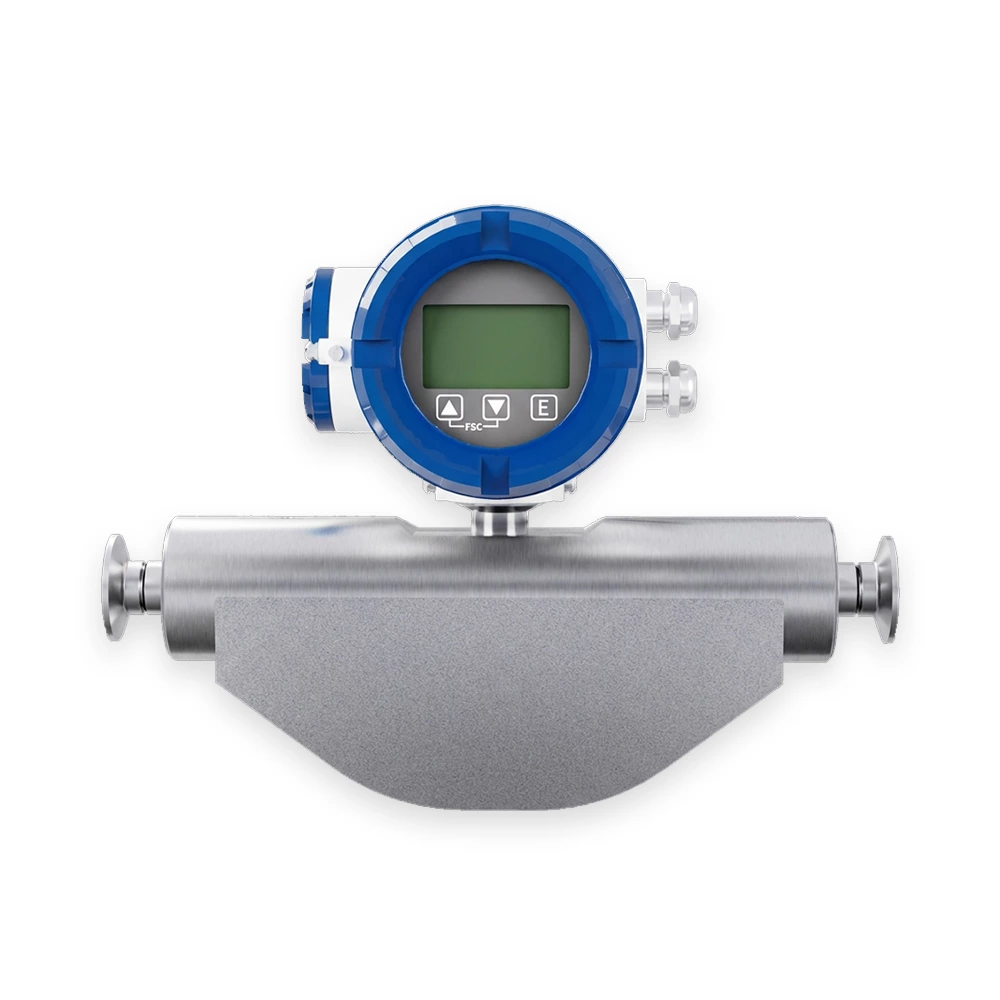
The FCC800 Coriolis Mass Flow Meter is suitable for marine fuel monitoring and shipboard flow measurement systems.
It can be used for:
-
Marine fuel oil consumption measurement
-
Bunker fuel monitoring systems
-
Engine fuel mass flow measurement
-
Fuel transfer and loading measurement
-
Ship energy efficiency monitoring
Because it directly measures mass flow independent of temperature, pressure or density variations, the FCC800 is especially suitable for marine fuel applications where accurate mass-based fuel accounting is required.
Its compact structure, reliable operation and low maintenance design make it suitable for onboard installation in limited spaces.
-
Measuring principle
The FCC800 operates based on the Coriolis principle.
When fluid flows through vibrating measuring tubes inside the sensor, the inertia of the moving medium causes tube deformation. The sensor continuously detects changes in vibration frequency, phase difference and amplitude.
-
The phase difference between inlet and outlet vibration signals is proportional to the mass flow rate.
-
The vibration frequency is related to the medium density.
-
The integrated temperature sensor measures process temperature directly.
Using proprietary algorithms, the transmitter converts these signals into:
-
Mass flow rate
-
Density
-
Temperature
-
Volume flow rate (calculated from mass flow and density)
-
Measurement system
The FCC800 transmitter is an intelligent measurement and control system built around DSP and ARM processors.
It ensures:
-
Accurate mass flow calculation
-
Real-time density compensation
-
Temperature monitoring
-
Stable signal processing
-
Strong self-diagnostic capability